
Article for MG-drivers and enthusiasts
How to make Your dull number plate lamps
brighter If You have a MG of 1972 onwards where the
number plate is lighted from the overriders of the bumper, I am sure You are having, or You had a lot of troubles with those tiny bulbs. It is a known problem, that the number plate lighting lamps are always a little dull, if they are working at last on the MG. In Austria this can be a MOT failure.
·
first
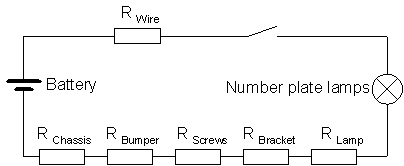
we have wires of copper and this wires have a electrical resistance. (shown as RWire ) ·
then
we have the chassis, where the current tries to go back to the battery (shown as Rchassis) ·
there
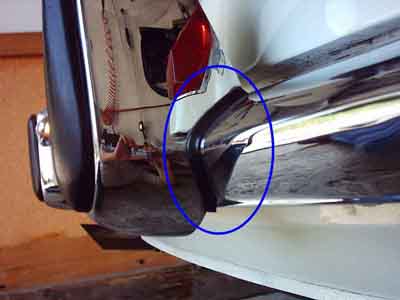
is also a resistance from the overrider to the bumper. Because the overrider sits on a rubber band on the bumper this is an electrical isolation. ·
as
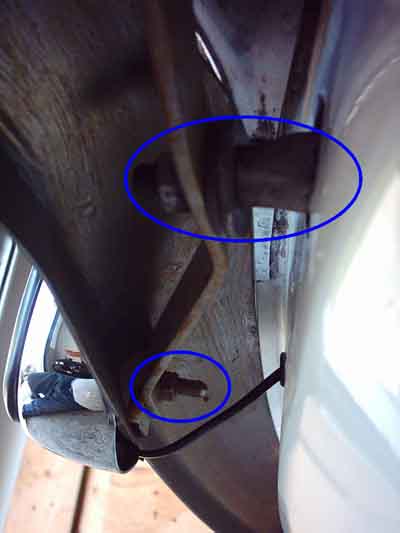
the bumper is mounted with screws on the chassis, we have a resistance called RScrews (see picture) ·
if
You look close, the lamp is just hold by pressure on the fixing bracket on the overrider. So, there is another resistance. (shown as RBracket) ·
if
You look even closer, the lamp is fixed with the standard bayonet. (shown as RLamp) Additionally
to all this, we have corrosion, oxidation which all increases the named electrical resistances. Just have a look and see how many
unwanted resistances there are. If one of those resistances goes to endless the lamps will not lit. (This is the same as the lamps on the Christmas tree. If one lamp gives (resistance goes to endless) all other lamps does not work.) To let our numberplate lamp work in an efficient way it is our main
task, to avoid all those parasitic resistances or get them as low (small) as possible. The easiest thing is, to shortcut as much as possible of those resistances. Here the way I did it: Then I put
the wire into the hose where the red wire goes to the lamp. This is a little bit a fiddle, but it looks nice. For 'water'-protection I used some heatshrink hose on the end, so dampness has no chance. On the lamp-side I also used a ring terminal to fix the wire on the mounting screw where the lamp is mounted on the overrider. (see picture) RBracket
can only be minimised (as I think), when smearing some petroleum jelly on the surface where the lamp holder fits in the bracket. This is true on the long term, because I think the petroleum jelly avoids the oxidation of the lamp holder and the resistance will still be low in the future (hopefully) Felix
Weschitz Date: 14. September 205
Just for imagination my little story: After rechroming the bumpers and the overriders, I also replaced the rubbers between the bumpers and the overriders.
I also protected the inner side of the bumpers with plenty of (similar to) waxoil. (the brown stuff you see on these pictures is waxoil) To protect the threads of the mounting bolts I used some fluid for bolt securing. After polishing the new rechromed bumpers, we then proudly took part at the club championship.
After the prize giving we made our way home. In the garage I just recognised,
that both of the numberplate lamps are not working. This hit me like a thunderlightning. Next day I started thinking……
 Before all
a little theory:
Before all
a little theory:
In the ideal world, You have a battery, the light switch and the numberplate lamp and some wires – with no resistance – and then back to the battery also with no resistance - as shown here
As we all know, the reality is not ideal, so we have a lot of parasitic resistances.
(see picture and shown as RBumper)
I put a wire from the bracket of each the two lamps to a solid (not rusty) chassis mounting bolt.
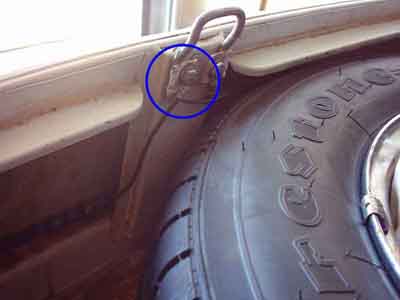
The best and nearest mounting bolt I found is the lock bracket of the boot.
There I fixed two wires in a ring terminal and crimped both wires. (see picture)
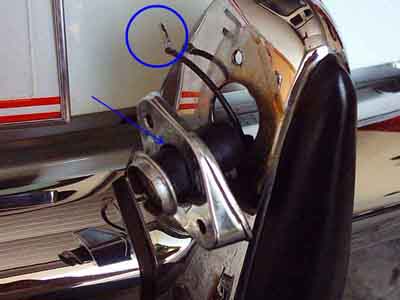
This action shortcuts the two resistances
RScrews and RBumper. The resistance RChassis
is a little bit lower. The next thing is to minimise the two other resistances.
The RLamp can also be minimised a little when smearing some
Petroleum jelly around the lamp. (I mean the metal part not the glass part of the lamp ;-)) This also keeps the oxidation on the lamp holder and lamp socket low on the long term.
Instead of petroleum jelly I used the same grease which I used to use on the battery contacts to avoid oxidation.
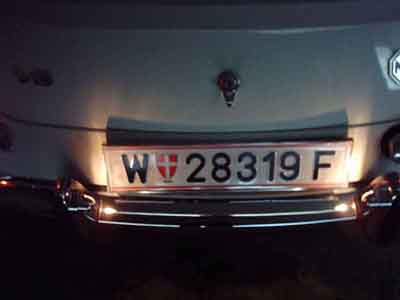
As You can see, my numberplate lamps are brighter then new. (see picture)
Nearby: All of the electrical consumers are working the same way. To get brighter lamps, just think of the return flow of the current to the battery.
Often there are a lot of such parasitic resistances which can be avoided.
Sometimes rusted or heavily corroded ground / earthing points do make troubles. Also corroded lamp sockets are a point of failure. The few pennies invested in new lamp sockets are worth the money.
So, hopefully Your numberplate lamps are now as bright as new;
and keep Your MGs on the road.
MGOC Member: A6421-3