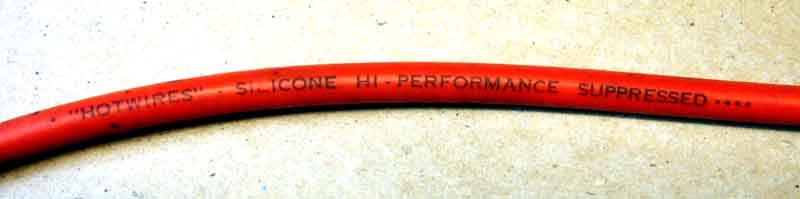
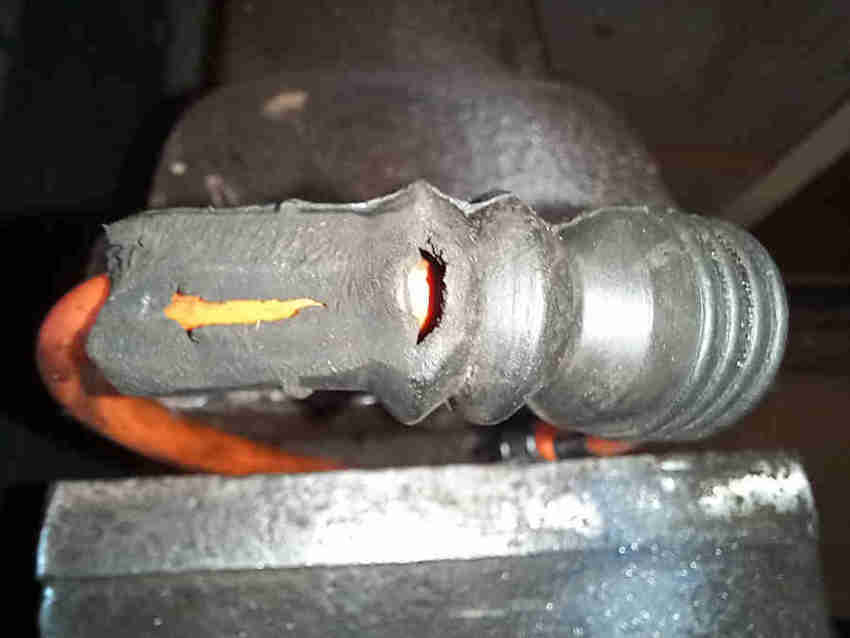
At first sight appears to have a single-strand resistive inner trapped under the crimped connector ...

... but cutting diagonally through the cable shows it as many very fine strands which seem to have an outer coat bonding them into a single conductor. Each strand is conductive.

Construction

After that the sky is the limit as far as construction, claims and price are concerned. There are many that have a spiral wound steel conductor, which may have the central core as merely a strengthening device, or may be an additional resistive conductor such as in the basic silicone leads above. There is even one (at least) with 'capacitors' and braided earthing straps.

Magnecor have published an interesting document 'The Truth About Ignition Wire Conductors' that is very scathing about the claims made by many of these 'high-performance' aka highly priced leads. It includes the following statements:
- In effect, (when new) a coated "low-resistance" spiral conductor's true performance is identical to that of a high-resistance carbon conductor.
- ... a test performed by Circle Track Magazine (see May, 1996 issue) in the USA, show that NO "low-resistance" ignition wires for which a horsepower increase is claimed do in fact increase horsepower - the test also included comparisons with solid metal and carbon conductor ignition wires.
- Claims by Nology of their "HotWires" creating sparks that are "300 times more powerful," reaching temperatures of "100,000 to 150,000 degrees F" (more than enough to melt spark plug electrodes), spark durations of "4 billionths of a second" (spark duration is controlled by the ignition system itself) and currents of "1,000 amperes" magically evolving in "capacitors" allegedly "built-in" to the ignition wires are as ridiculous as the data and the depiction of sparks in photographs used in advertising material and the price asked for these wires!
- Unless you are prepared to accept poorly suppressed ignition wires that fail sooner than any other type of ignition wires and stretch your ignition system to the limit, and have an engine with no electronic management system and/or exhaust emission controls, it's best not to be influenced by the exaggerated claims, and some vested-interest journalists', resellers' and installers' perception an engine has more power after Nology wires are fitted. Often, after replacing deteriorated wires, any new ignition wires make an engine run better. (My emphasis as that goes for anything on an MGB)

There are lead sets with right-angled cap connectors from £13 - GHT106 for 25D4 and GHT184 for 45D4. The latter have the same connectors but are said to be longer, beware those suppliers that imply they are the same, you may end up with the shorter ones.
MGOC set GHT106 for the 25D4 with right-angles both ends, clearance to the column UJ now:
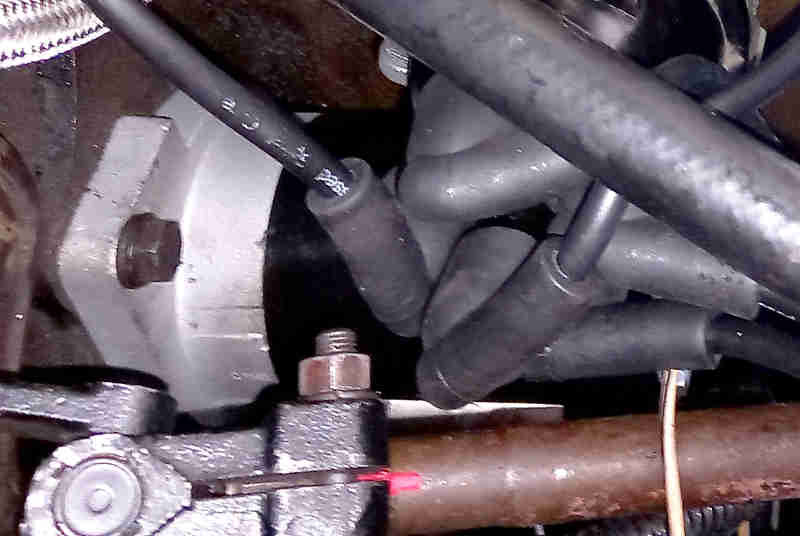
But the leads still need to be routed carefully:
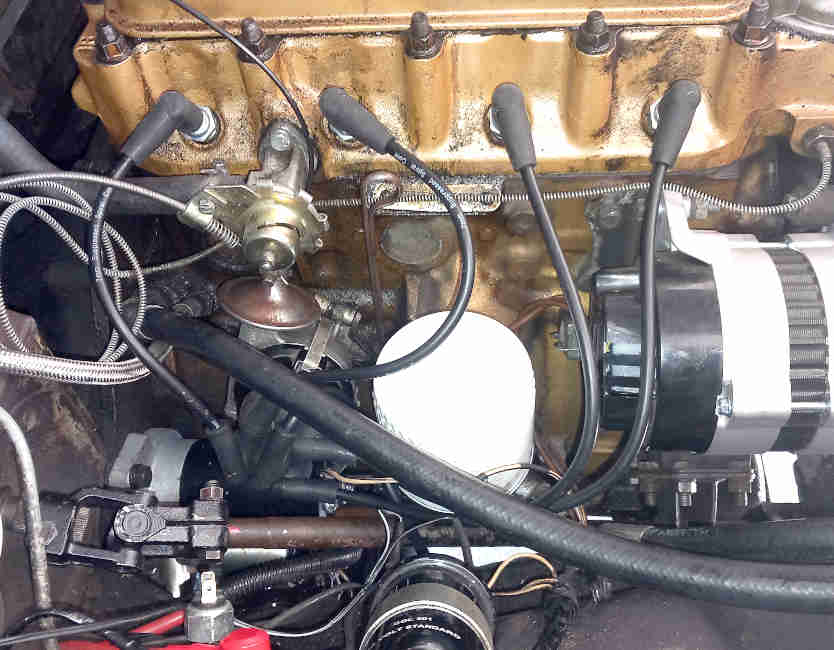
1, 2 and 3 are OK but 4 has to be routed to the left and under the heater valve cable to avoid the heater valve.
The coil lead has to be routed up then behind leads 1 & 2 to avoid the rack shaft (it looks close here but isn't):
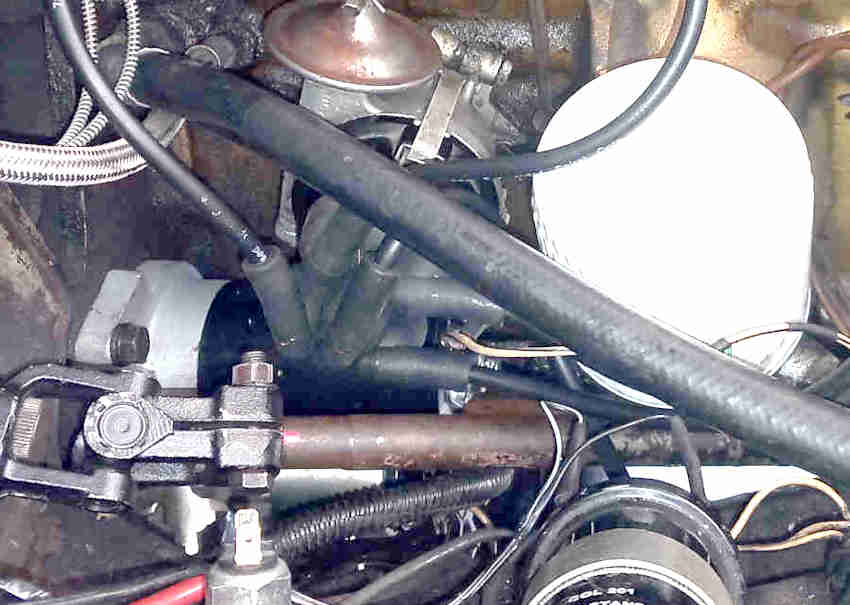
Note the one-piece replacement CB column UJ but the damage occurred with the original type as can be seen higher up this page.
If they were longer (GHT184?) it may be possible to cable-tie them into a group as they came off the cap then fan out neatly to the plugs and coil but there we are. Custom made would be considerably more expensive, the coil lead for the V8 - shorter than any 4-cylinder lead - cost over £7 eight years ago. My Halfords set (probably a generic replacement for the MGB but with straight connectors) have the plug leads 8cm to 10cm longer (which allowed No.4 lead to be wrapped under and round the others and away from the column UJ) and the coil lead 20cm longer.
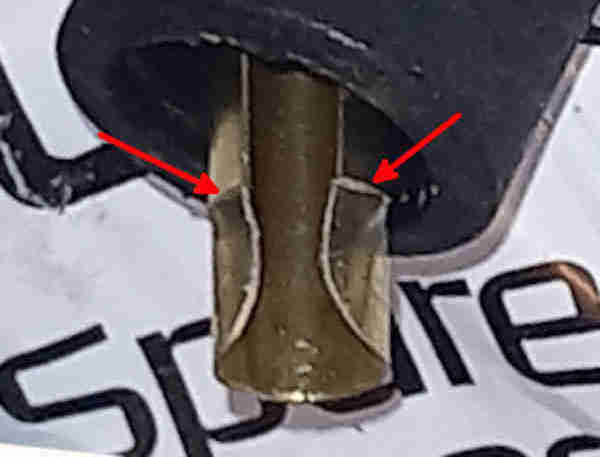
But getting them fitted to the cap is a bigger issue! The brass connectors instead of being a circle with a segment cut out are horseshoe-shaped with the distance from the top of the loop to the opening bigger than across the loop, and it's very difficult - even with a lot of pressure and the cap flat on the workbench - to get the end of the connector started in the cap and coil sockets. A few mm up the connector are projections (red arrows), this makes the connector fatter and even when the connector has been started in the socket you cannot get these projections past the socket entrance meaning it only goes in a few mm (instead of 10mm or more) and they are very easy to dislodge again:
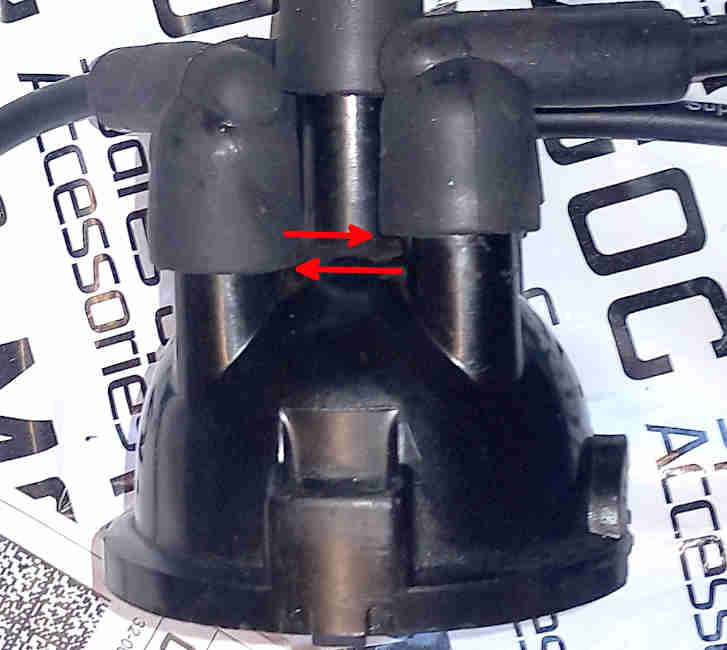
I had to pinch the open ends in a bit to form a circle instead of a horseshoe, and then the connector goes in further - left red arrow compared to the right but still needs a lot of force - and is held more firmly:
The old Halfords 'HOTWIRES' are far better designed and manufactured:

It was only when Googling to find if these are still available and if so how much that I discovered they are made by 'Nology' with claims of superior performance including 'built-in capacitors to store energy'. Better connectors aside what a load of rubbish. You would have a job manufacturing an electrical component that didn't have some capacitance, and why would you want to 'store' HT energy instead of getting it to the plug? Google AI's (I know, I know) opinion is:
• The Reality: While companies like Nology have showcased dyno tests on classic MGBs, the classic car community and independent testing note that the high-performance claims of specialized capacitive or spiral-wound leads are often overhyped. Most of the performance gains felt by drivers actually come from simply replacing old, deteriorated spark plug wires with crisp, new ones.
Whatever the claims they only cost £13 from Halfords in 1999, and the MGOC £17 basic silicone leads on now are performing just as well.
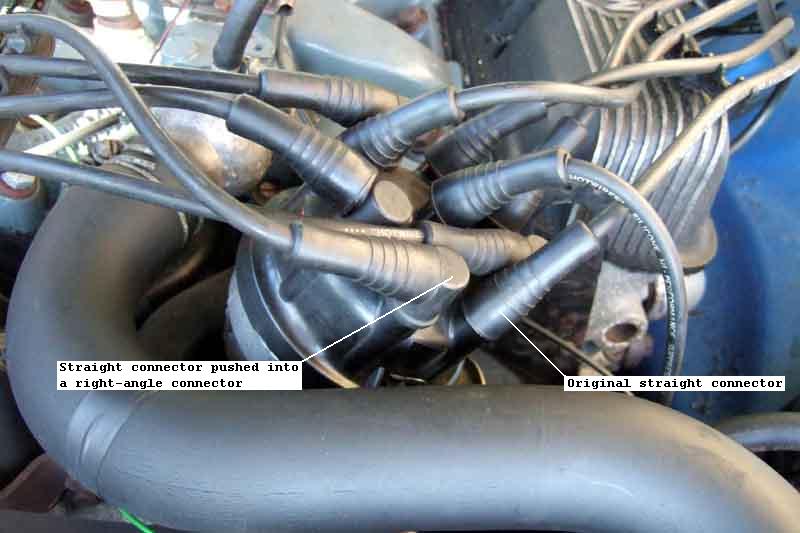
V8 cap and leads: Right-angle connectors (recovered from the old leads) fitted to the MGOC right-bank silicone leads. They incorrectly came with straights and were pushed down by the bonnet insulation:
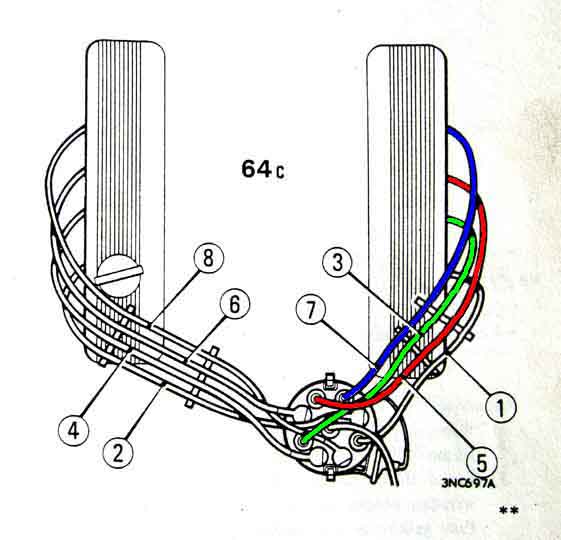
Separate leads 5 and 7 in the combs with lead 3 to prevent possibly parasitic ignition in cylinder 7 when 5 fires. Note the Leyland Workshop Manual Supplement states the direction of rotation incorrectly but the drawing of the firing order is correct: (image from Leyland MGB GT V8 Workshop Manual Supplement)