
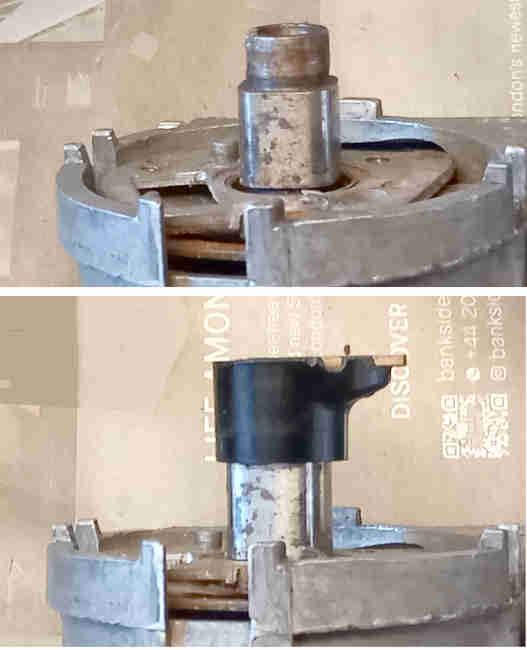
Note that 25D4 rotors are 16.5mm high and 45D4 rotors 20mm high. It looks like the rotor has been rubbing on this 25D4 cap, there had been a misfire which may or not be associated: (Nat, Bristol)
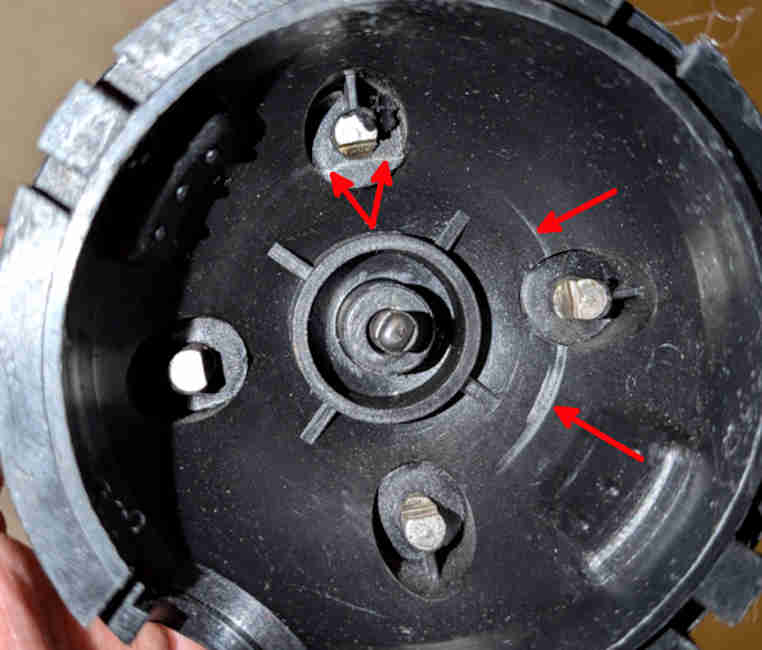
On my original Lucas 25D4 there is a 2mm clearance between the top of the rotor and the closest part of the cap which is the housing for the centre contact ('A'), and for the cap to be fitted correctly the rotor can't be any higher than this. There is a further 3mm clearance to the ring around that and the ribs radiating out from the centre ('B') so on the face of it no chance of the rotor contact rubbing on the cap in the area shown on Nat's:
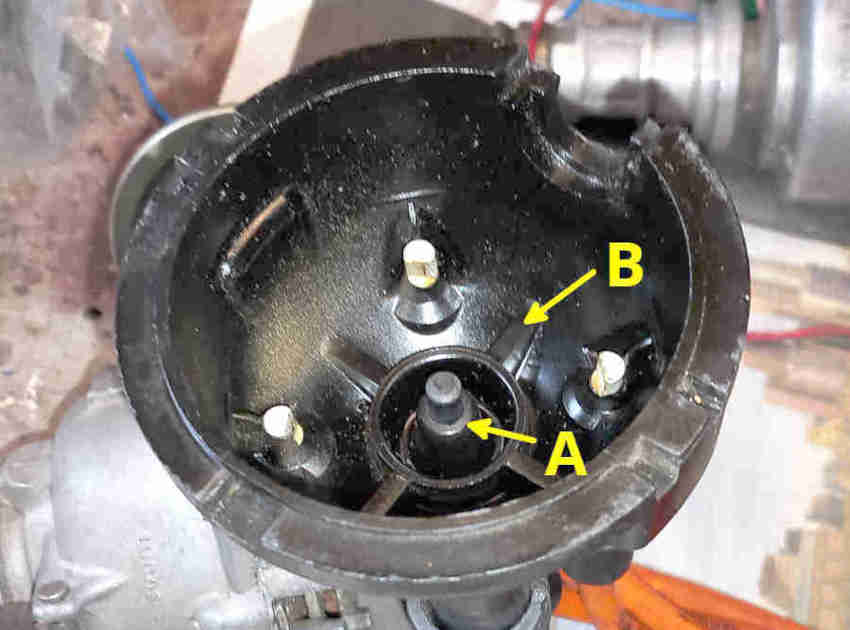
However Nat's distributor is an after-market electronic (points replacement module fitted by the manufacturer or supplier) so there may be dimensional differences in any of the distributor body, shaft, rotor or cap affecting clearances, Nat's cap is clearly different to mine with shorter ribs and the plug contacts recessed further which will bring the area of the cap between the contacts closer to the rotor. It's also possible that the contact on a previous rotor was angled for some reason instead of being at right-angles to the shaft, the current one isn't.
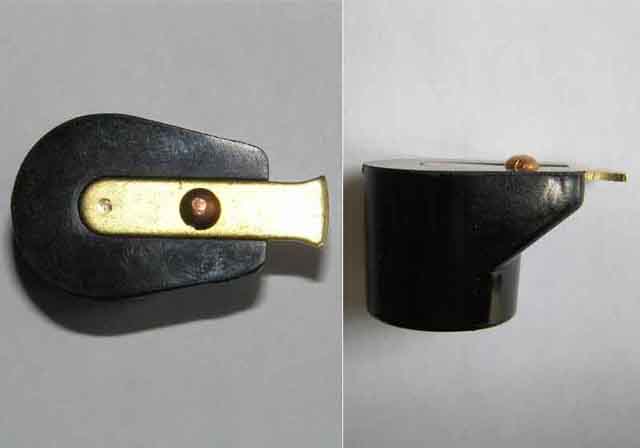
Suspect rotors: An original rotor on the left with no rivet, and an aftermarket on the right with round-headed rivet. Note that the rotor on the right is from an aftermarket electronic ignition system and has an extended base containing magnets to trigger a Hall-effect device:
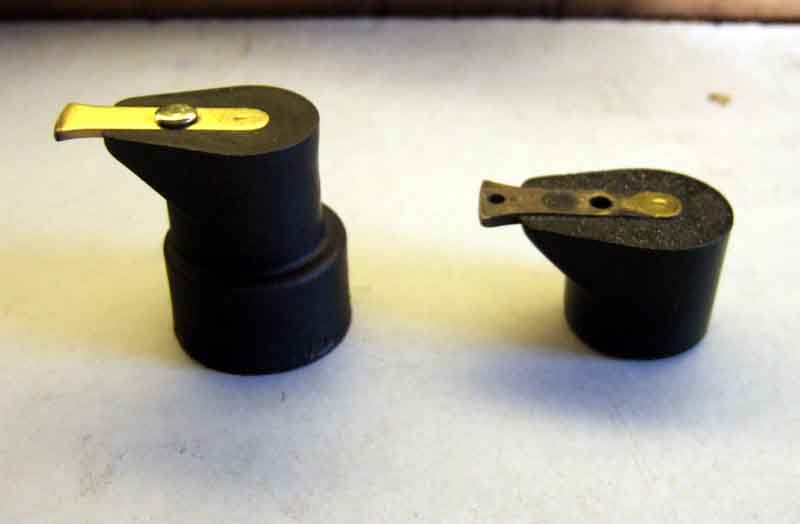
Showing the rivet inside the circle of the base i.e. too close to the distributor shaft and hence prone to breaking down:


Another style of currently available rotor. Still with the round-headed rivet but fitted outside the circle of the base i.e. further away from the distributor shaft and so probably 'safe':

This rotor from a 25D4 has a domed rivet rather than flat and looks to be positioned slightly further out than the top rotor, but not as far out as the one immediately above. This failed in service within hours of being fitted (ironically as a result of the loss of the carbon contact in a nearly new cap that had damaged the also nearly new rotor), firstly causing intermittent 'fluffing', before total failure. The good news is that the owner was demonstrating the fluffing to his mechanic when it totally failed, and he (the mechanic) had come equipped with a new one. The bad news is that it chose to fail on a very busy road with traffic flowing at motorway speeds but no hard-shoulder. Fortunately it was a quick fix to drop in the new rotor: (David Bolton)
A 'red' rotor from Distributor Doctor, with improved insulation material and no rivet:
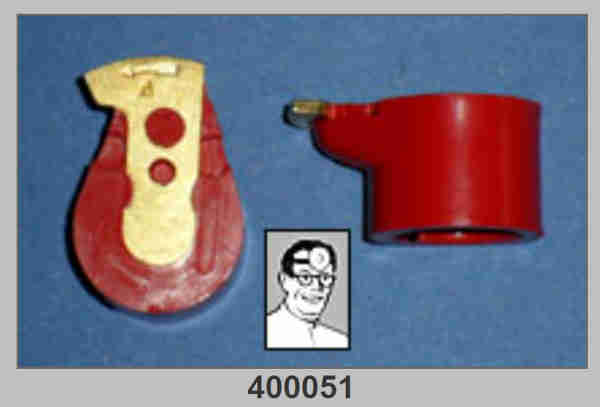
Note that a number of manufacturers have jumped on the bandwagon and are producing red rotors, but several have the same problems as before. For that reason Dist. Doc. embosses his with 'DD', but presumably that is not beyond faking either!