4-Cylinder pre-engaged:
Earlier 2M100 pre-engaged starter on 18Gx engines: A - battery cable stud and large 12v spade. B - standard-sized solenoid operate spade. No 'boost' contact:
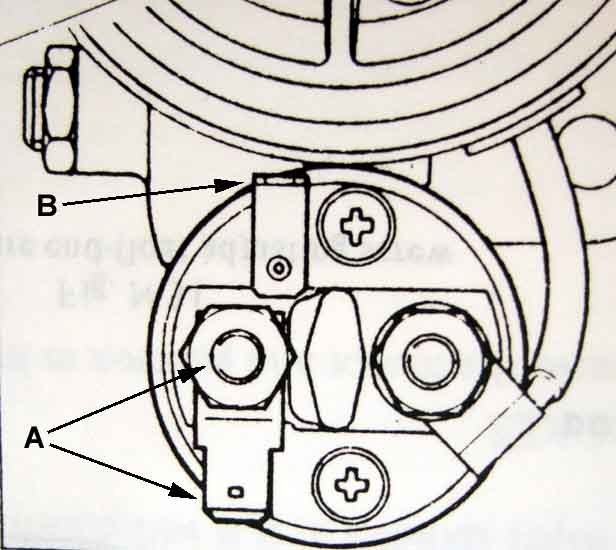
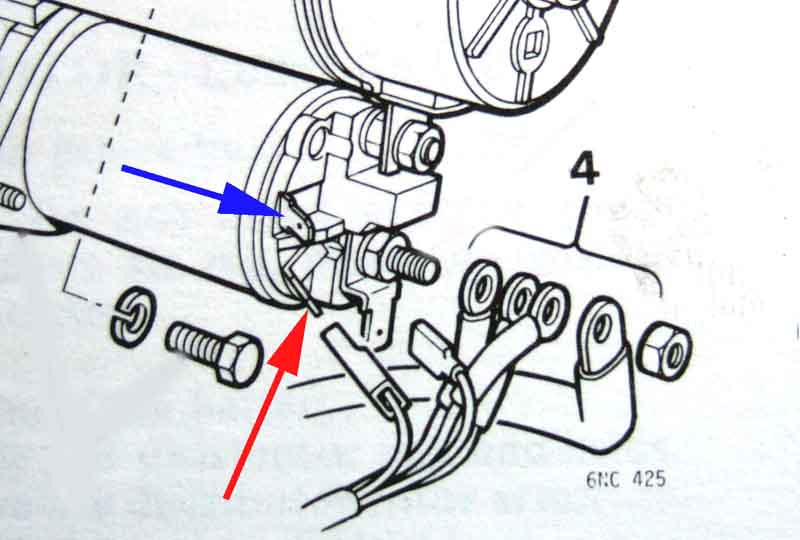
Later 2M100 pre-engaged starter on 18V engines, V8 starter is similar: Everything bracketed as '4' goes on the stud - battery cable and two or three brown wires. There should always be at least two thick brown wires (one from the alternator the other to the rest of the cars electrics), there may be a third standard-gauge brown wire which goes to the alternator for voltage sensing or another thick brown which goes to the rest of the cars electrics for greater current carrying ability. The large spade (9.5mm) on the stud is for compatibility with earlier models. The standard-sized spade (6.3mm) lower left (red arrow) is for the solenoid operate wire which is a thick white/brown or white/red (or possibly a brown/white, diagrams vary). The small spade above that (4.8mm) is for the coil boost wire (rubber bumper 4-cylinder and all V8s) which is a standard gauge white/light-green (white/light-blue on V8). (Leyland Workshop Manuals)
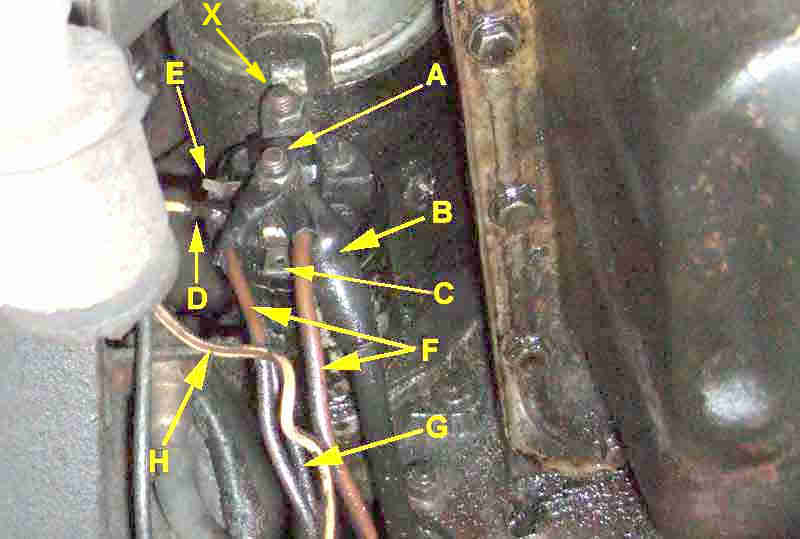
In practice: 'A' is the battery cable stud, 'B' the battery cable, 'C' the large spade for brown wires as used originally. 'F' are the brown wires to the cars electrics and the output from the alternator, 'G' is the additional smaller gauge wire to the alternator on cars that used battery sensing. 'D' is the solenoid operate terminal and 'H' the solenoid operate wire, 'E' is the coil boost terminal only used on rubber bumper cars and V8s. 'X' is the output stud of the solenoid with the nut clamping a copper strap leading into the motor:
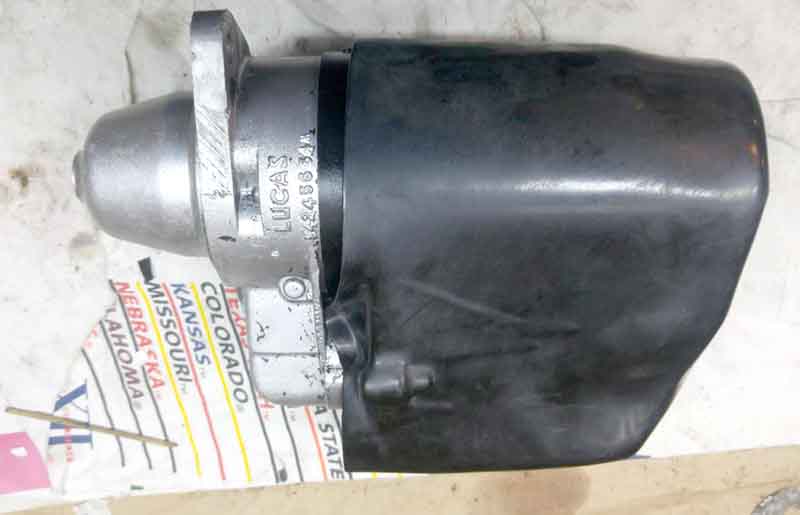
Rubber boot over the starter connections from May 72: (Ahmed EL Abasiry, Canada)
Intermittent no crank - two test bulbs wired to points 'X' and 'D' in the above to monitor if power is reaching the solenoid when it doesn't reach the motor:
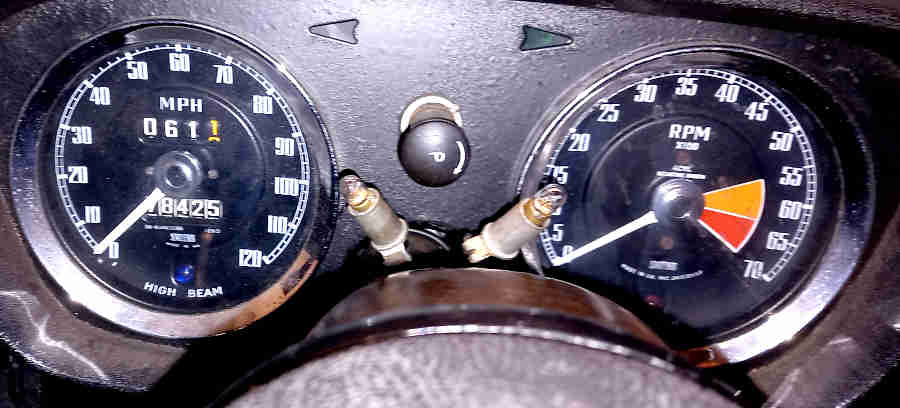
There is a definite loud click or clonk when the fault occurs, and the bulb connected to 'X' doesn't light. But is that the solenoid operating but not passing power to the motor? Or the solenoid not getting power from the relay? I'd always imagined it would be easy to tell the difference between the click from the relay and the clonk from the solenoid, maybe so if your head is under the bonnet. But the relay is surprisingly loud and I don't know how loud the solenoid is when the motor isn't energised, so bonnet closed and in the driver's seat I can't be sure which I can hear especially when it's unexpected and only once every never. With the second bulb piggy-backed to 'D' if that lights when I just get the click I know it's the solenoid contacts or the motor. If neither bulb lights then I know power isn't reaching the solenoid so I can move the piggy-back to the relay output and remove the other bulb from 'X'. If that bulb still lights then I know the relay is OK so it must be the wire and connections down to the solenoid.
Why don't I just buy a new starter? Suppose it still happens because it's one of the other two. So just swap the relay then? It could still be one of the other two and do I swap the motor next? And if it still happens? For me diagnosis beats swapping willy-nilly every time.
In fact shortly after fitting the second test bulb I commenced giving the key a brief turn most days so my focus was on the bulbs - when the fault occurred. Only one bulb lit so power was reaching the solenoid but not the motor - replacement (lightweight!) motor ordered. I also realised that if I removed the battery cable and brown wires from the solenoid and clipped them together so everything worked except the motor proper I would be able to hear the solenoid without the motor, as well as the relay without the solenoid, and they are quite distinctive. In fact I can hear the relay click a fraction of a second before the solenoid clonks (camera sitting on the pedal cover, you may need to turn the volume up):
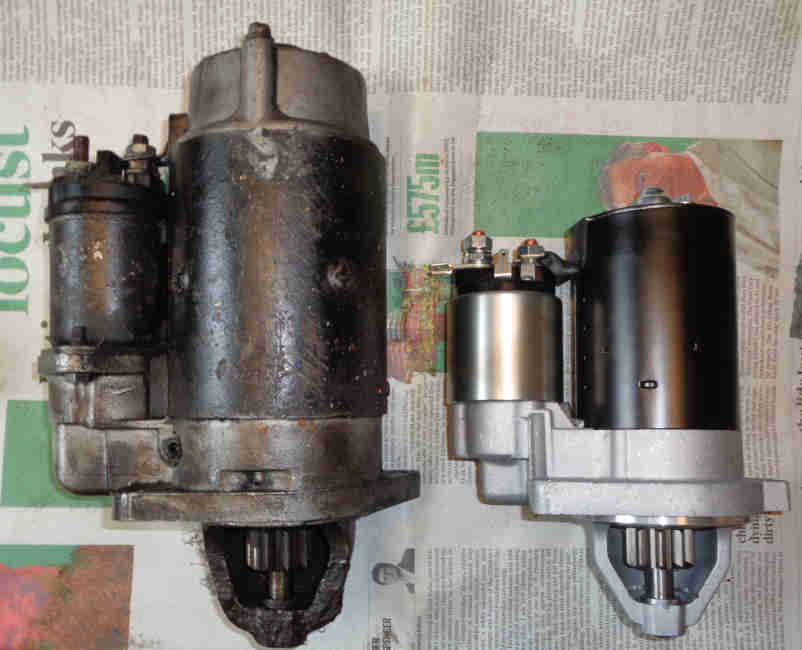
As well as being half the weight of the original the new lightweight starter is very much smaller and easier to handle:
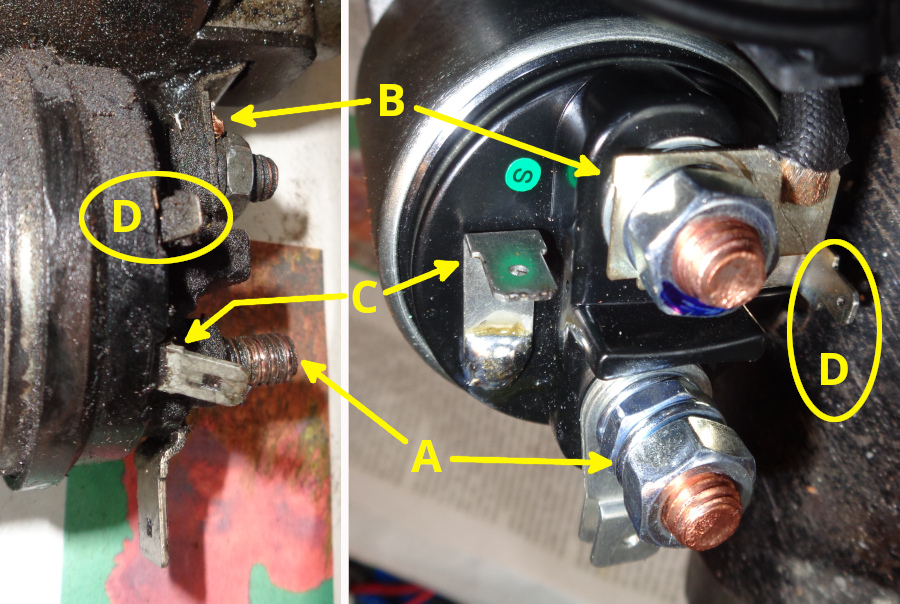
Connections slightly different, 'A' is the battery cable stud; 'B' the connection between solenoid and motor; 'C' the solenoid operate spade; 'D' the smaller coil boost spade (not used on CB 4-cylinder cars) is on the other side of the solenoid:
Distributor not fitted yet but it looks lost in the space:
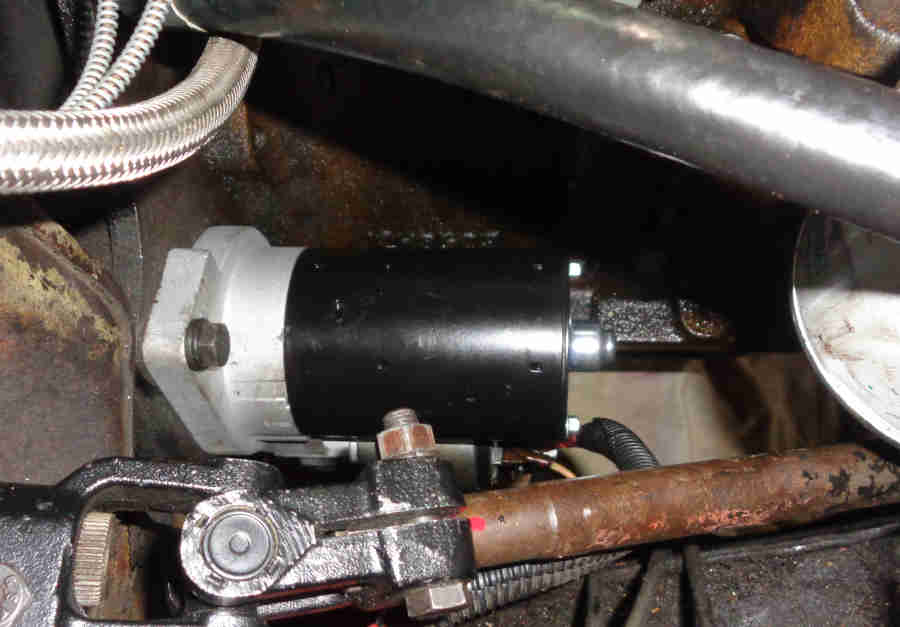
Original 2M100 starter, solenoid removed. The 'copper'-looking cylinder has to be steel - maybe with a copper coating to resist corrosion - as this is the plunger that is drawn into the solenoid body when it is energised:
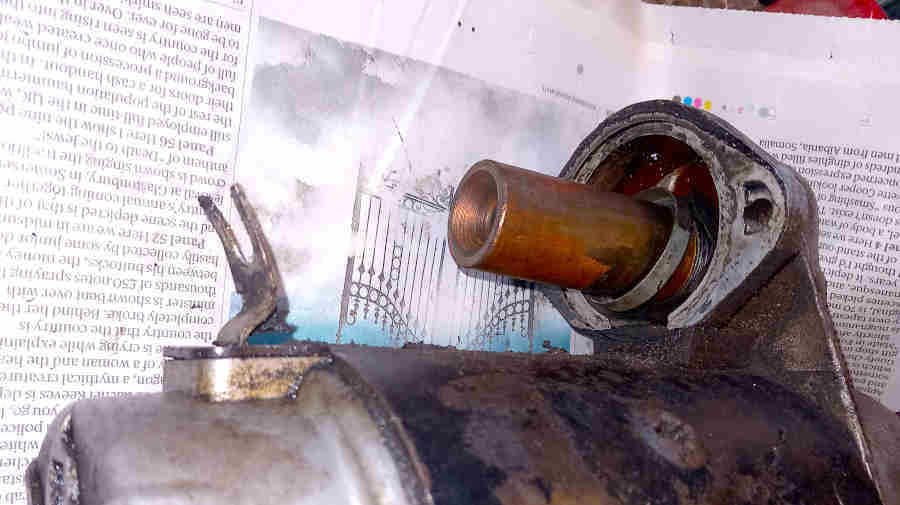
The solenoid body, large spring to push the plunger out and withdraw the pinion from the ring-gear when released. It had a very thin rubber boot that ripped on removal:
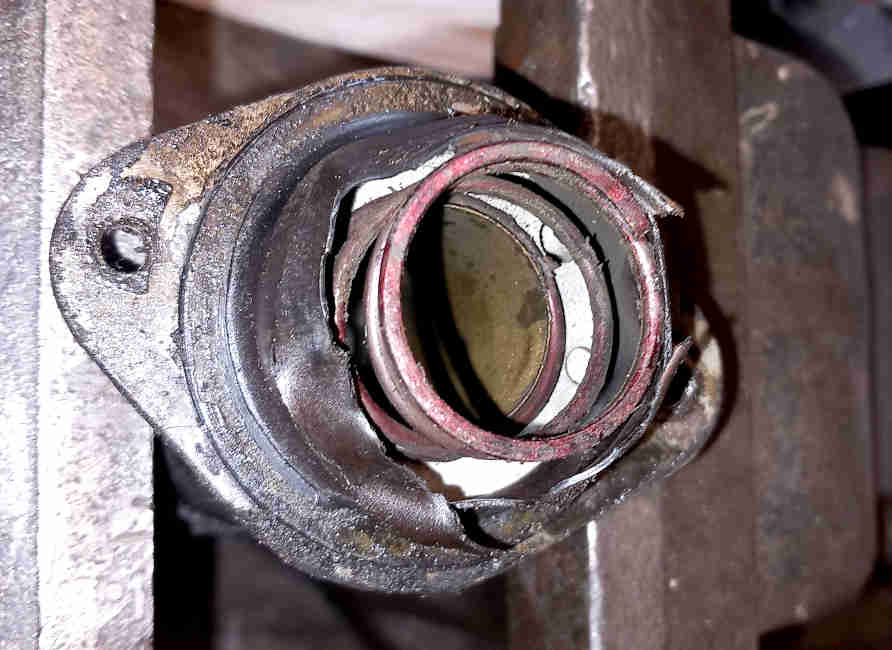
Looking down inside the solenoid body, the central 'pin' is the business end of the copper bar that connects the motor to the battery cable:
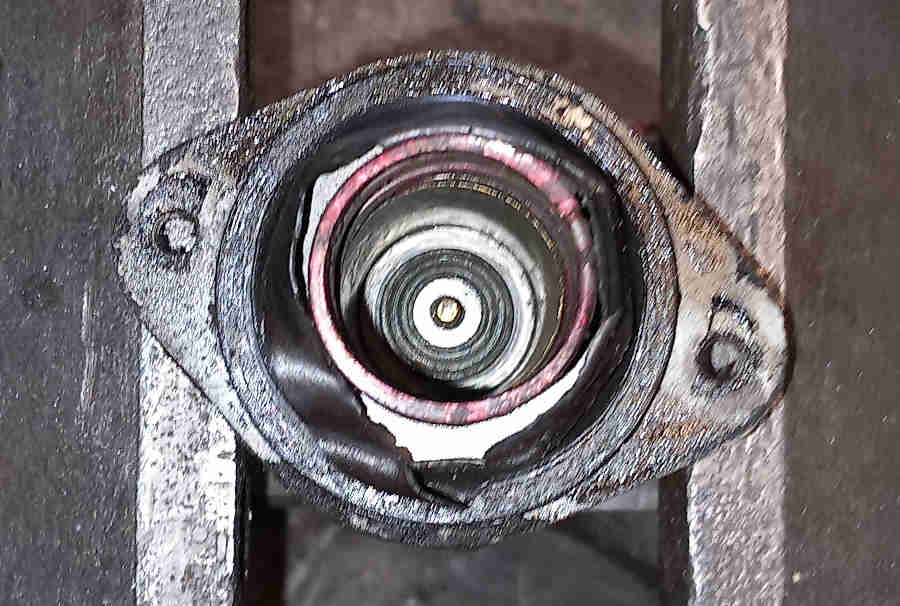
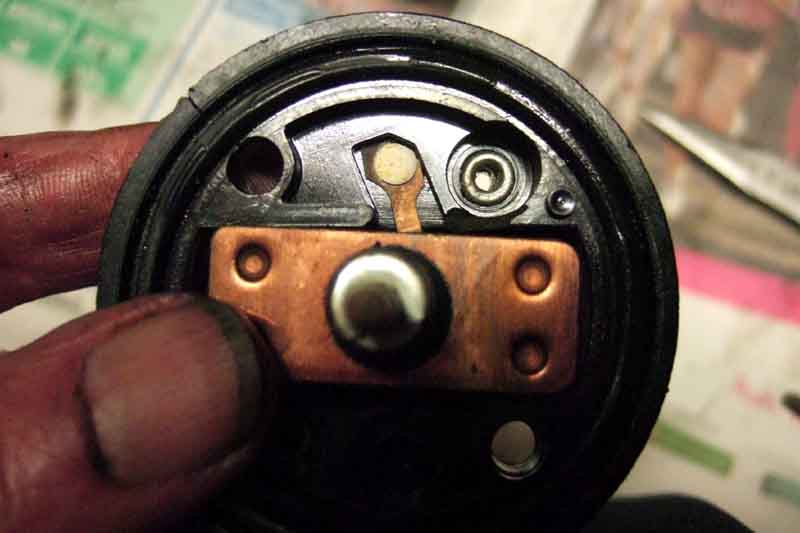
The copper bar that connects power to the motor, with its own return spring, clean copper both ends unlike the studs below. Two thick wires for the low-resistance solenoid pull-in coil at 3 o'clock (motor connection) and 9 o'clock (solenoid operate spade), the thinner hence higher resistance hold-in winding has one end spot-welded to the solenoid body (earth) and the other end connected to the right-hand pull-in wire (solenoid operate spade):
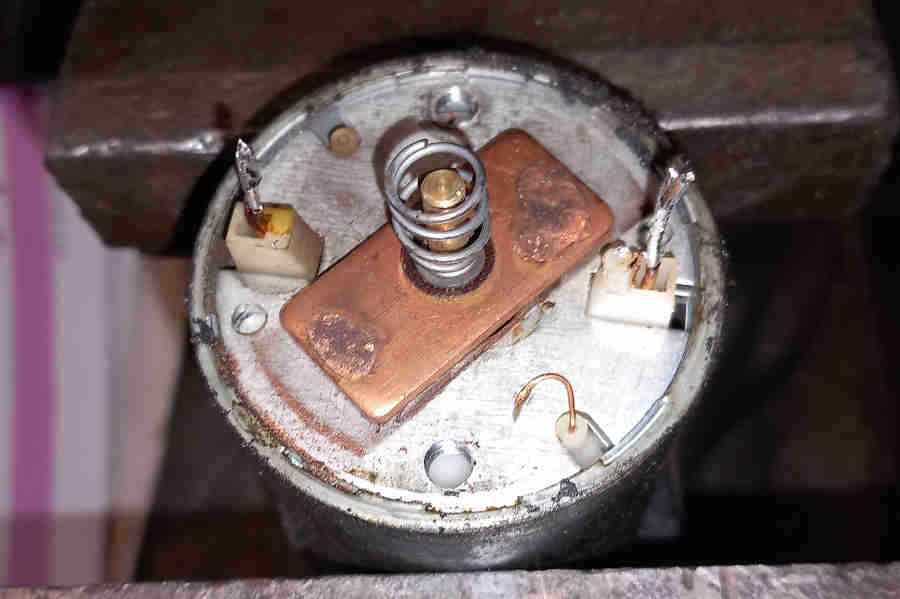
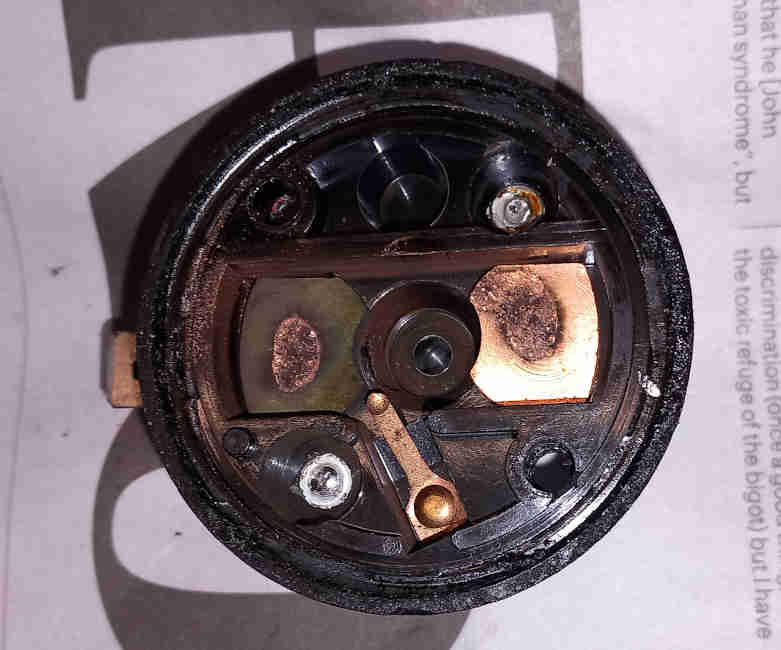
End cap with the base of the two studs that is bridged by the copper bar - battery cable stud on the left motor connection stud on the right. At the bottom is the 'coil boost' connection used on rubber bumper ballasted ignition. For some reason the motor stud is clean copper except for arcing where the contact was made and broken but the battery cable is heavily discoloured over the whole surface other than at the area of arcing and took quite a bit of scratching to get to bright copper. Whether this discolouration is something to do with the very intermittent failure to connect power to the motor I don't know but the burning is much more pronounced than on the V8 solenoid although that starter had only been in use about five years, and still shows some overall discolouration on one (probably also the battery cable stud going by the alignment of the coil boost contact on both caps) of the studs:
V8 specifics:
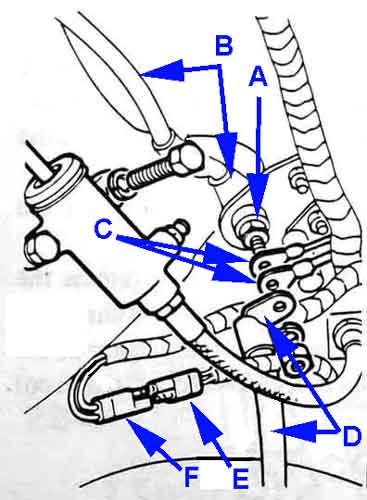
The intermediate connection in the V8 battery cable: 'A' is the insulated stud on its mounting plate bolted to the toeboard; 'B' is the cable from the battery mounted to the top part of the stud; 'C' are the two brown wires from the harness; 'D' is the short length of battery cable to the starter solenoid stud; 'E' is the 2-pin connector on the short sub-harness going to the solenoid spades; 'F' is the other half of the 2-pin connector on the main harness tail. This connector can only be assembled one way (and is the same as the cooling fan connectors): (Leyland V8 Workshop Manual Supplement)
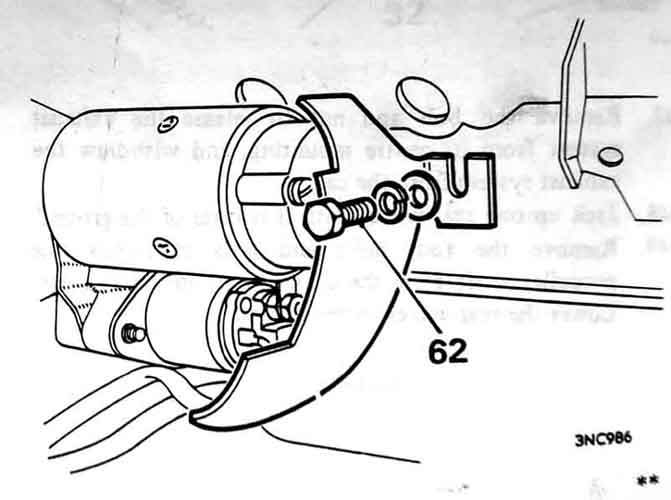
V8 starter heat-shield, the correct item is moulded heat-resistant material with a metal bracket riveted on. Not shown but the off-side exhaust down-pipe is immediately to the right of this, but it also passes underneath so although the end of the solenoid and starter are shielded the lower body of the solenoid isn't. The heat eventually weakens the ability of the solenoid to hold in once it has connected power to the motor and battery voltage has dropped, and it chatters as if the battery is flat. When Vee came to me it was just a tin sheet which wouldn't have helped much with keeping heat off the solenoid, with one of the bracket rivets broken away so with relatively light pressure it could by pushed against the battery cable stud shorting it out! (Leyland V8 Workshop Manual Supplement)
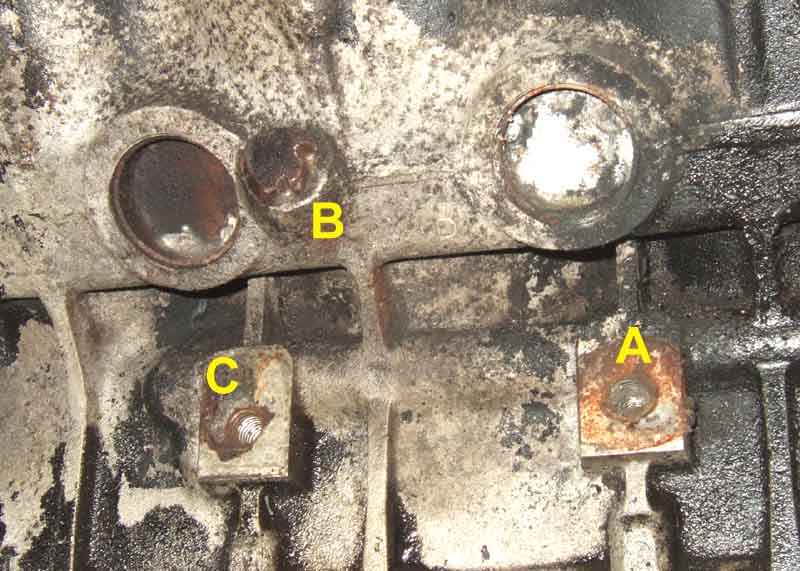
At least one person has said his block doesn't have a tapped hole for the fixing bolt, but both my original and an engine from elsewhere both have it. 'A' is the lower mounting point for the engine mounting plate, 'B' is the block drain plug, and 'C' is the hole for the heat shield:
Vee's replacement starter: A copper bar bridges the two stud contacts A and B when the solenoid operates and is supposed to connect power to the small coil boost contact as well. But that contact (arrowed) is bent back ...
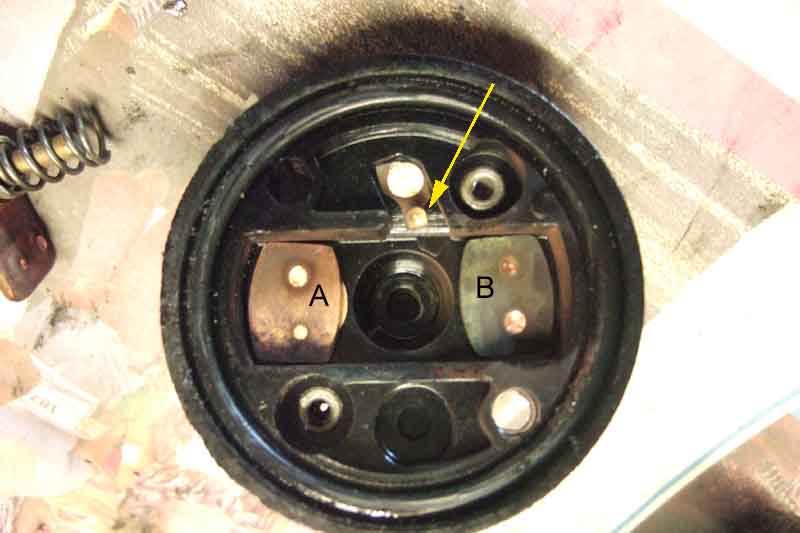
... so that the copper bar misses it altogether, and has obviously never worked on this starter that I fitted in December 1999 as a newly rebuilt item:
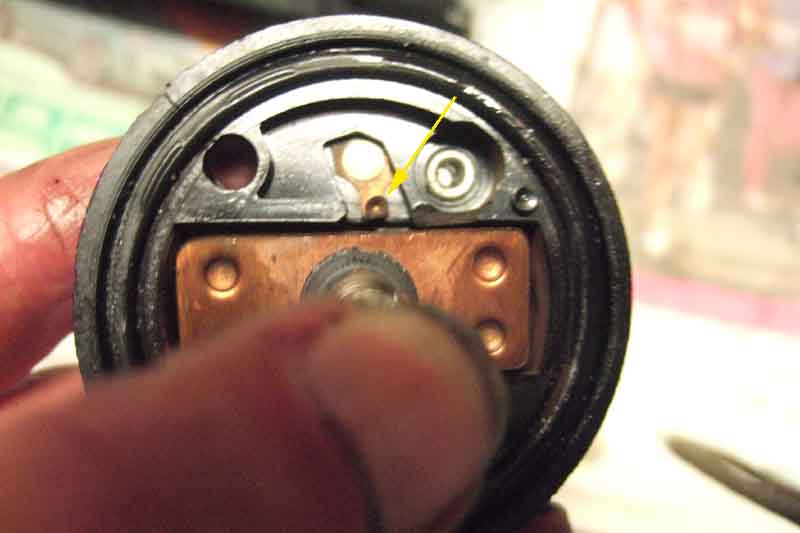
The coil boost contact is straightened and positioned so that the copper bar touches it and pushes it down just before it reaches the two studs: