


July 2026: The usual service supplies (Comma Classic oil and Mann W916/1 filter) from GSF but a bit of a shock on the oil - full price was £57.46 when last year I paid £28.49! OK discounted to £43.10 with a further 30% discount for signing up to text messages which brought it down to £36 (other places typically £35 plus delivery or from eBay without) but even so - thank you, Trump! Not so pleased with GSF this time - took a long time for anyone to appear at the counter, then a very long time before he came back - with the wrong oil - Comma X-Flow MOT 20W/50. I queried it and he said that was the only 20W/50 they had, even though I had bought and paid online and the order form showed Comma Classic. I started peering at the can for info on API grade (there was none I could see!), he wandered off then came back with the correct oil. X-Flow is about half the price of the Classic and with no API info I really didn't fancy that.
September 2025: A question has been asked as to whether 20/50 oil with 'high' ZDDP can be used in the gearbox as the poster had read that 'additives' shouldn't be used. The Leyland Workshop Manual is adamant that anti-friction additives must not be used in the gearbox and overdrive as they can cause the overdrive to slip. ZDDP is usually referred to in connection with reducing wear in 'flat tappet' engines like the MGB, it does this by creating a sacrificial layer on highly loaded surfaces such as the cam lobes and tappets filling microscopic grooves in the surfaces so reducing wear in that way rather than with very slippery oils. It's almost certainly the case that every oil suitable for the MGB engine will contain ZDDP at some level and as the manuals specify the same oil for the gearbox as well as for the engine then the simple answer is 'yes, oils with ZDDP can be used in the gearbox'. However the oil in question had ZDDP at 1500ppm, which is the highest I had come across, the previous highest being 1300ppm, and looking round the internet there are any number of sites (including oil manufacturers) saying 1000 to 1400 is a suitable range, 1200 is ideal, and above about 1400 or 1500 starts to cause increased engine wear from pitting and corrosion. On that basis I wouldn't use 1500ppm in either engine or gearbox.
July 2025:
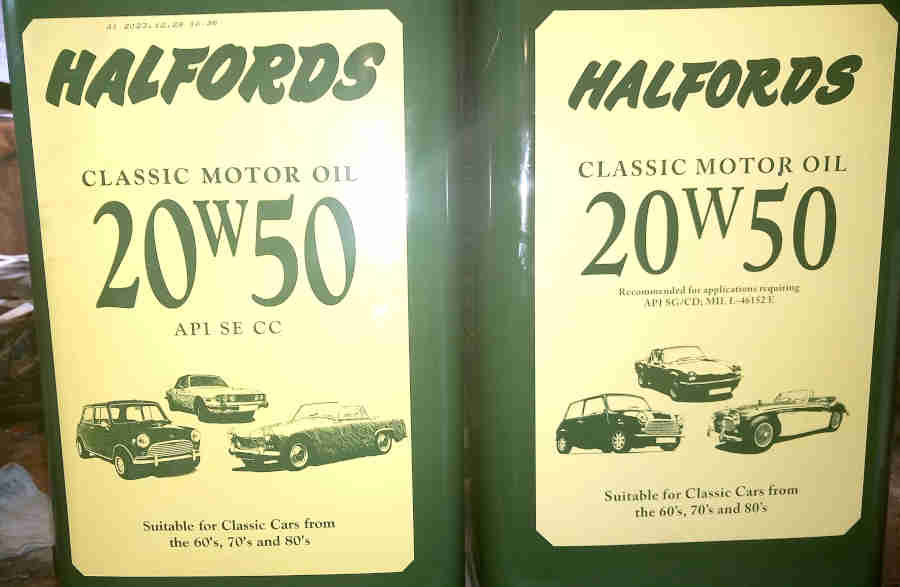 Watch out: The colour has changed from green to brown and the spec from API SE to SG which has lower levels of zinc and phosphorus (protects cam and followers). The can still shows 'suitable for cars from the 60s, 70s and 80s' but the website spec sheet says 'suitable for cars from 1989 to 1996'. Inputting a 1970s reg no to the page comes back with 'not suitable'. Phoned to complain and with a bit of beating around the bush with someone for whom English wasn't their primary language she logged it. A couple of days later I had an email saying they would send me a £15 voucher and saying to take the oil back and they would replace it with a suitable oil. Wrote back and said as the 'oil finder' on their website states 'none found' really I need a refund, which they subsequently confirmed, so fair enough. Logged it on the usual websites with others saying they hadn't noticed the change, but one respondent saying API grade are supposed to be 'backwards compatible'. If that's the case why don't all Halfords 20W/50 oils come up as being suitable for all cars going back to those that originally had API SA? Halfords list Comma Classic which despite the can shown being API SE also says 'not suitable' but Description states 'specially blended for Classic Cars from the 60's, 70's and 80's' so should be compatible. They also have Millers Pistoneeze shown as API SJ 'for use in classic cars that incorporate modern filtration systems', no years listed, but no statement of 'not suitable' either so in theory should be suitable for the MGB with full-flow filtration, although SJ is a later spec (that ZDDP thing again) than SG of course.
The original version was reputedly made by Comma, the tech sheet for their Classic 20W/50 still shows API SE with decent levels of zinc and phosphorus and it is green as Halfords Classic used to be. Cheaper from the likes of GSF to boot.
March 2023: It's been four years since I last updated this section, I gave up because things were changing every year and every year I had to search anew for the data. At that point I defaulted to using Halfords Classic (which now has a plastic pull-up spout with ring-pull cap that is torn off the spout to ensure a seal). It's available locally, it's said to be made by Comma, and their Classic (click Download Technical Data Sheet) has 800ppm of zinc and 700ppm of phosphorus plus 2200ppm of calcium which I'm sure is good enough for Bee the mechanical components of which have been running for over 30 years and that's just with me. If I were running with new cam and followers I would probably opt for Fuzz Townshend's Heritage 20W/50 which has 1300ppm of 'Zinc as ZDDP'.
For a couple of years or so I've seen a certain group of people banging on about zinc dithiophosphate (ZDDP) in oils and how a reduction of levels of this additive in modern oils will damage your engine. An apparently clear case of modern versions of something
But first a digression into viscosities and how they have changed over the years. I'm old enough to remember when GTX came out, but turned my nose up at it as the 'GT' label was being stuck on anything and everything at the time, most of it cheap and tacky. But eventually it 'got its knees brown' and had been around long enough, as well as being more readily available it seemed to me, so I started using it. Originally 20W-50, probably some time in the 80s or early 90s it changed to 15W-50 which was obviously an improvement. Come the late 90s or early 2000s it changed again, but this time to 15W-40 - not so good. I immediately noticed a drop in hot idle oil pressure in the V8, which is low enough to begin with, although no change in the roadster. Unhappy about this I started using Halfords 'red can' in the V8 which was 15W-50, and as I couldn't see the point of spending the higher amount on GTX for the roadster switched that as well. But in the last couple of years Halfords have dropped the 15W-50 'red can', the next available grade also being 15W-40 - back to square one. They do however have a 20W-50 'Classic' oil (that comes in a 'proper' metal can to boot). I did buy that last year, but was concerned to find the screw cap had no seal on it, so technically anyone could put anything in it (subsequently I realised the 'seal' was coming off with the screw-cap on those cans, but they have now adopted a plastic pull-up spout with a ring-pull cap that is torn away from the spout). As yet another digression and while researching this topic I came across people recommending buying Mobil 1 loose from Sh*t-Fit, taking their own cans. When others expressed concern about the potential for contamination, if not being sold something completely different, a couple of people stated that they had contacted Mobil who confirmed that they did indeed supply their oil loose to Sh*t-Fit. So they might, but what guarantee have you or Mobil got that some Sh*t-Fit scum-bag hasn't padded it out with something else? The same thing used to concern me many years ago when petrol stations had oil dispensers on the forecourt - you cranked a handle and dispensed it into a small can, then poured it into your engine. Then the can went back on the shelf to gather more dust and flies ready for the next customer! Some people used to insist on bottled oil, but all the garage did was use the same system for filling the bottles! But back to the subject.
So I'm not keen on Halfords Classic 20W-50 because of it being unsealed (I subsequently discover that all the cans come with a plastic insert but it's hit and miss when unscrewing the metal cap as to whether it stays in the can or in the cap, so you can't tell if anything has been added or removed!), there doesn't seem to be any other 20W-50 readily available locally. Then in this month's Enjoying MG MGOC are advertising Castrol XL 20W-50 and recommending it for its higher levels of ZDDP (but see below), so maybe I ought to look into this ZDDP thing after all. Is there something in it? Or is Roche simply repeating what he has seen elsewhere, like he did with his "you will ruin a battery by storing it on a concrete floor" comment of a year or so ago (some years ago someone posted on an MG mailing list "Don't store batteries on concrete floors or you will ruin them". There then followed a long and heated debate about just what physics might or might or might not be involved in causing a concrete floor to damage the internals of a battery, which again I didn't get involved in as it seemed like rubbish to me. A couple of weeks later the original poster came back and said "No no no, I meant that if you put an old battery on a concrete floor and it leaks it will ruin the concrete!" Oh, how I laughed!).
The gist of a number of articles I have read is that yes, ZDDP is necessary to 'cushion' certain sliding components, and the flat tappets and camshaft lobes of our engines seem particularly prone to wear without it, new cams and tappets failing in as little as a few hundred miles. A progressive reduction in zinc (and other additives) has been required by environmental agencies over recent years both to reduce pollution and because they can reduce the life of catalytic converters. The American Petroleum Institute (API) grades oils into 'service categories' and containers are labelled with (amongst other things) 'API' followed 'SA' to 'SM' for petrol and 'CA' to 'CI4' for diesel according to oil formulation and performance. SA to SH are obsolete (our engines originally used SB, SC, SD and SE), as are CA to CE. Originally each new formulation was an improvement and backwards compatible, until it comes to SL which is where the reduction in zinc and other additives started happening. The European equivalent of the API is the ACEA (Association des Constructeurs Europeens d'Automobiles, or European Automobile Manufacturers Association). They have their own way of grading oils which seems much more complicated than the API with class, category and year indicators so I'll stick with the API ratings.
The recommendations I have managed to glean are:
As to practicalities in the UK:
- MGOC Castrol XL20W-50 20 litre drum at £96 delivered, but needs rather a lot of space, and you have to consider storage life and conditions, I've read five years maximum and frost free. They also have 4.5L cans at £29, plus postage. They are rated API SE/CC so suitable for our engines, but don't have the benefits of the later SF to SJ formulations.
- Halfords Classic 20W-50 is also API SE/CC, £17 per five litres i.e. a bit more than a gallon so comparable to the MGOC bulk price without the storage issues. Personally I'm not happy about the unsealed cap though. I subsequently discover that all the cans come with a plastic insert but it's hit and miss when removing the cap as to whether it stays in the can or in the cap!
- A fellow MG-er has some old-stock Unipart Green 20W-50 (part no. GUL7005) that is rated at API SF/CL and so also suitable. Only two places seem to stock it online - Rimmer Bros at £14 and mini spares at £13. No indication of API rating on either site, so check first, although it does seem that where you can still get 20W-50 in various brands they are to SJ or earlier ratings and so suitable.
- The Mini supplier of the above makes me think of Min-Its locally to me, and sure enough they do stock 20W50 but it's Valvoline VR1, at API SL and £19. I certainly don't want to muck about with mail order, so it's a toss-up between Halfords Enhanced Diesel SJ 15W40 or Valvoline SL 20W50, and I opt for the latter (subsequently rejected).
- January 2012: Comma Sonic (NLA) at API SL CF is claimed to have about 0.2% each of Phosphorus and Zinc, which is typically double compared to most of what I have found so far. Note Comma Classic (API SE CC) has less than half this and looks to be in the same cans as Halfords Classic.
April 2018: Comma X-Flow type SP still available with the data sheet showing the same quantity of zinc at 0.11%/1100ppm. Unipart 20W/50 Mineral Classic Engine Oil PROM300, API SF/CD and "Formulated to meet the demands of petrol and diesel engines of older non-turbo design engines. Good anti-wear, anti-oxidisation and anti-rust properties". An 'older' format, the product data sheet indicates that 'Zinc Alkyldithiophosphate' is at a concentration of 0.5% to 1%, so not precise but definitely not exceeding 1% or 1000ppm. New kid on the block is Classic Oils Heritage 20W/50 apparently endorsed by Fuzz Townshend. API SL/CH-4, but with 1300ppm of Zinc as ZDDP i.e. significantly more than others.
December 2017: Not much to add: Comma X-Flow type SP, the datasheet for which specifies API SL CF and Zinc 0.11% Calcium 0.30% Phosphorus 0.10%. Millers Classic Sport 20W/50 now states SPI SL/CF but the only statement about ZDDP is "It is formulated with full ZDDP (zinc phosphorus) for ultimate protection" which could mean anything. A couple of sources for Comma found by Googling, and rather cheap at £14 for 4L, whereas 5L of Millers from Opie Oils is £38! Beware Comma Classic 20W/50 which despite being API SE CC only has 0.08% zinc and 0.07% phosphorus. Ditto Castrol Classic XL 20W/50 API SE/CC which only has 0.08% 'Zinc as ZDDP' i.e. the same as modern oils and no mention of phosphorus.
March 2015: I've got Comma Sonic 20W/50 in both cars at the moment but have been a little concerned about the very slow rise time in the V8 over winter so was hoping to change to a 15W/40 to API SJ, but have not been able to find any. Note that Halfords 15W-40 enhanced Diesel oil is now labelled Mineral Petrol and Diesel Oil rated ACEA A3/B3 and API SL i.e. no longer SJ, however it still has the same CF/CF-4 diesel rating as previously. It's made by Comma and they were able to tell me that it contains 0.11% Zinc, 0.1% Phosphorus, and 0.3% Calcium. Also Comma Sonic is no longer produced, the replacement being Comma X-Flow type SP. This is also SL with the same zinc and phosphorus as Halfords Mineral Petrol and Diesel Oil, but only 4 litres. Millers Classic Sport 20W/50 is still SJ, with 1250ppm or 0.125% ZDDP, so about the same as the Halfords and Comma SLs i.e. not as much as Comma Sonic used to be. I suspect environmental regulation has ordered the reduction.
January 2012: As well as coming across the reference to Comma Sonic the Peter Donlan subsequently wrote saying he is now using ZDDPlus stocked by Frost in a new engine. At the same time Peter Burgess has also mentioned he uses Zincoat from Chemodex. As they are both subject to UK law on claims, I'm hoping the products 'do no harm' at least.
September 2011: A cautionary tale. A pal has had to have his engine rebuilt after only 20k, cams and followers pitted and worn were the main problem. He has his car serviced by a local classic specialist (it was previously restored by them), subsequently enquired what oil they used, and was told it was a semi-synthetic 10W/40 to API SL. The garage wasn't aware of ZDDP issues (nor apparently interested when told), so said pal is replacing it with Halfords Classic (20W/50 API SE). As this tends to confirm problems with SL (and hence SM), especially with newly rebuilt engines, I shall definitely steer clear of it in future. I have recently read that previous use of earlier formulations protects the cams and followers to some extent if changing to SL, but only seen one reference to that, and the writer may be getting it confused with 'lead memory effect' for valves and seats with the change from leaded to unleaded petrol. After a couple of years using Valvoline VR1 (20W/50 API SL) in the V8 I did think it had become a bit noisier, and one contained noticeably less than 5 litres, so had already stopped using it anyway. This spring I got a couple of 5L cans of Unipart Mineral 20W/50 API SF at £17 each, used one and shall keep one for next year, then try to stay one or two cans ahead. Failing that Halfords Enhanced Diesel (15W/40 API SJ). Classic Oils is advertising a number of classic mineral 20W/50 oils, all (bar three where there is no API formulation specified) at API SF and SG. They also have Penrite running-in oil which should be used for the first 300 miles to bed in the rings and bores on a newly rebuilt engine.
August 2009: After a bit of effort I got some data sheets from Halfords. These confirm they are made by Comma, but also contain some down-right confusing information on ZDDP content. For the Classic 20W/50 under hazardous ingredients it states ZDDP at <1% i.e. less than 1%. Fair enough for Elf and safety info, but of no use to us as other product information quotes ZDDP constituents at much less than this, typically less than 0.1%. But then looking at every other Halfords oil, including full synthetic and enhanced mineral diesel, which have very different API classifications, they all specify between 1 and 10%! I.e. anywhere from 10 to 100 times the amount needed!!
Given the amount of web site and mail list chatter about the loss of ZDDP you would think that plenty of additives would be available given the number there are for other engine, gearbox, petrol etc. situations. But I can only find references to one, made in America, and reputedly only one eBay supplier of that in the UK. As there are no warranties as to how effective it is, or more importantly that it won't wreck your engine even faster than having no ZDDP in your oil, I'll leave you to find it for yourselves.
May 2009: Came across a page from LN Engineering and Charles Navarro (who he?). A loooong article (120k of pure text) entitled 'What motor oil is best for my air-cooled Porsche' but is largely relevant to our engines. He concurs with much of the above, but states that there is no evidence of Porsche catalytic converters suffering from the higher levels of zinc and phosphorus in earlier formulations for motor car engines, although he also says motorcycle oils are usually SG, SH or SJ with excellent anti-wear characteristics but will kill catalytic converters. He states that Zn and P (ZDDP) levels of 0.12% (1200ppm) for normal drain intervals, 1450ppm for extended drain intervals are ideal. Comparing wear he states increasing ZDDP from .03% to .05% in an engine with 180lb valve springs reduced wear by 90%! With 205lb springs increasing from .05% to .095% similarly reduced wear by 90%. He gives the following table of additive averages in a range of oils tested or examined, but unfortunately doesn't say what the oils are:
| API | P (ppm) | Zn (ppm) | B (ppm) | Mo (ppm) | Ca (ppm) | Mg (ppm) | Na (ppm) | Total Detergents |
| SE-SJ | 1301 | 1280 | 151 | 357 | 1936 | 293 | 214 | 2443 |
| CI-4 | 1150 | 1374 | 83 | 80 | 2642 | 199 | 2840 | |
| SL | 994 | 1182 | 133 | 273 | 2347 | 109 | 22 | 2479 |
| CJ-4 | 819 | 1014 | 26 | 2075 | 7 | 2082 | ||
| SM | 770 | 939 | 127 | 122 | 2135 | 13 | 139 | 2287 |
He prefers good quality oils in the first place to using additives, says rates of 2000ppm as recommended by some are simply not needed and too much can be as harmful as not enough. He repeats the target is 1200 to 1400ppm, and gives rates of addition using STP or GM EOS to achieve it. But of course you need to know what the amounts are to begin with, and unfortunately there is nothing in the article about this, although there may be in the many links. One posting found by Googling reports Castrol as saying SM grades with reduced Zinc and Phosphorus are known to cause problems in classic engines. They recommend their Syntec for classics, it contains a minimum of 0.12%/1200ppm of Zn, Phosphorus not mentioned. But to throw it all up in the air again I happened on a posting somewhere from said Charles Navarro saying he has correspondence from Castrol saying their GTX 20W/50 will remain at 1300-1400ppm, and their new Syntec 20W/50 also has those levels!
I found a set of Castrol UK product data sheets (click on 'View Complete Technical Data Sheet List") which make interesting reading. Amongst the many products the following levels of zinc and phosphorus are specified:
| Product | ACEA | API | Zinc | Phosphorus |
| Classic XL 20W-50 | SE/CC | 0.08 | ||
| Classic XL 30 | SB | 0.084 | 0.077 | |
| GTX 15W-40 | A3/B3 | SL/CF | 0.1035 | 0.093 |
| GTX High Mileage 15W-40 | A3/B3 | SL/CF | 0.1035 | 0.093 |
| GTX Professional 5W-30 | A1/B1 | SL | 0.099 | 0.091 |
| GTX Professional 10W-40 | A3/B3 | SL/CF | 0.0933 | 0.091 |
Many other commonly available products are listed (e.g. Magnatec, Diesel and Motorcycle) but don't have entries for zinc or phosphorus content. So far from Classic XL 20W/50 having more protection, it actually has less than either standard or high-mileage 15W/40, which have the highest of all Castrol products checked.
Castrol products for the USA are very different and product data sheets are listed here (click on "View all Product data Sheets). For all GTX standard and high-mileage viscosities whilst there are entries for zinc and phosphorus in the tables there are no values shown. For the Syntec products there aren't even any entries. GTX Diesel 15W-40 has 0.13 and 0.11 respectively, and 'GRAND PRIX MOTORCYCLE 4-STROKE' products have 0.11 and 0.10 respectively.
I did a similar search on Mobil UK product data sheets. Some like Mobil 1 Fuel Economy 0W-30 quote 0.10 phosphorus, Syst S Special V 5W-30 0.08, Super 3000 XE 5W-30 0.08, Synt S 5W-40 0.09, Mobil 1 0W-40 0.10, Super 3000 Formula R 5W-30 0.05, SHC Formula V 5W-30 0.08, Super FE Special 5W-30 0.10, LL Special G 5W-30 0.09, SHC Formula MB 0.08, Syst S ESP 5W-30 0.08. No entries for zinc entries, and the remainder of the Mobil products either didn't have phosphorus entries or they were blank.
References:
http://www.opieoils.co.uk/pdfs/Is-there-a-flat-tappet-issue.doc - flat-tappet issues.
http://motorcycleinfo.calsci.com/API.html - API Service Categories.
http://lukoil-lubricants.com/info/classification/00007/ - ACEA and API classifications.
Castrol UK product data sheets.
Castrol US product data sheets.
Mobil product data sheets.
Valvoline Racing VR1 product data sheet.
Mixing and switching between mineral, semi-synthetic and synthetic oils.